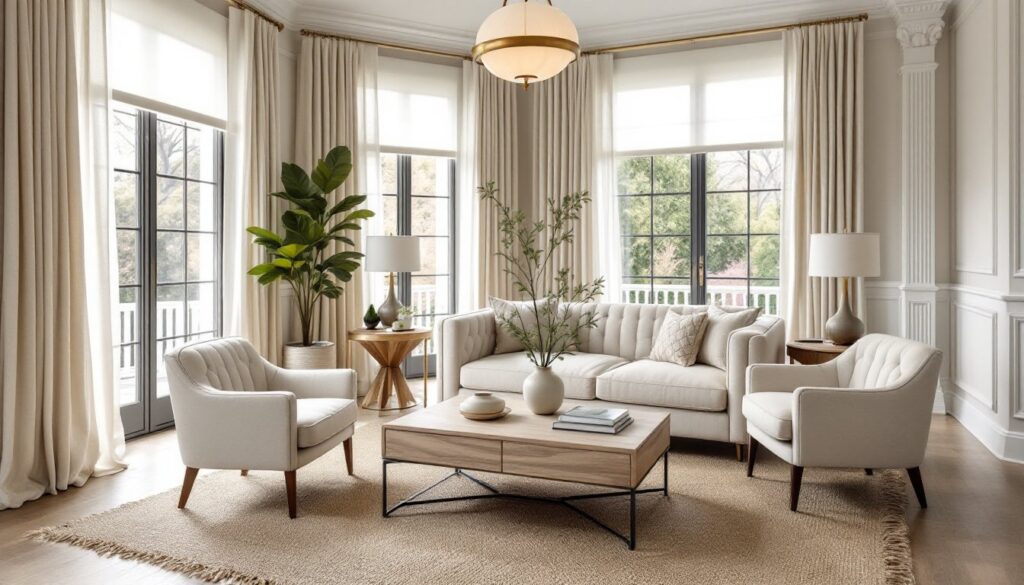
Creating a luxury white living room isn’t about sterile showroom vibes or impractical maintenance nightmares. When executed properly, an all-white palette delivers a sophisticated backdrop that lets architecture, texture, and quality materials take center stage. The challenge lies in avoiding the flat, cold look that plagues poorly planned white spaces. This guide walks through the essential design elements, material choices, and practical maintenance strategies needed to pull off a high-end white living room that feels inviting rather than institutional.
Table of Contents
ToggleKey Takeaways
- A luxury white living room balances architectural detail, quality materials, deliberate contrast, and professional finishes—skipping any element results in a space that reads as builder-grade rather than custom.
- Texture is essential in monochromatic design; layer at least four to five distinct textures in different scales using boucle upholstery, natural fiber rugs, rattan accents, and nubby throw pillows to prevent a flat, cold appearance.
- Select warm whites with yellow, beige, or greige undertones (like Benjamin Moore’s White Dove) and test paint samples throughout the day, as undertone coordination across trim, walls, and furniture prevents disjointed looks in your white living room.
- Invest in performance fabrics and professional-grade finishes like lacquer for woodwork (rather than flat paint) to maintain both aesthetics and durability, especially in households with children, pets, or frequent entertaining.
- Implement a four-layer lighting plan—ambient, task, accent, and decorative—using 2700K-3000K LED bulbs and dimmers to avoid harsh, institutional vibes while showcasing architectural features and artwork.
- Commit to regular maintenance including fabric protection, monthly vacuuming of natural-fiber rugs, weekly dust mopping of hardwood floors, and annual reapplication of Scotchgard to keep your white living room pristine without professional help.
Why White Living Rooms Exude Timeless Luxury
White serves as the universal neutralizer in interior design, making spaces appear larger and architectural details more pronounced. High-end homes have favored white palettes for centuries because the color amplifies natural light and creates a gallery-like setting for statement furniture and artwork.
The psychology behind white’s luxury association runs deeper than aesthetics. White signals cleanliness, order, and the resources to maintain both. A pristine white room suggests the homeowner has the time, help, or commitment to upkeep that less forgiving colors don’t demand. This perception of effort translates to perceived value.
Unlike trendy colors that date a space within five years, white remains architecturally neutral across decades. Many high-end homes incorporate white as a foundational element precisely because it won’t need updating when design trends shift. The longevity of a white palette also means investment pieces, whether a custom sofa or handcrafted millwork, remain relevant longer, improving cost-per-year value.
Essential Elements of a Luxury White Living Room
A successful luxury white living room relies on four core components: architectural detail, quality materials, deliberate contrast, and professional-grade finishes. Skimping on any one element results in a space that reads as builder-grade rather than custom.
Start with architectural interest. Crown molding, coffered ceilings, wainscoting, or picture rail molding add dimensional shadows that prevent walls from looking flat. If your room lacks these features, consider adding them. Standard 3.5-inch baseboard should be upgraded to at least 5.25-inch or taller profiles in a luxury space. Casing around doors and windows should be proportionally scaled, 3.5 to 4.5 inches wide for standard 8-foot ceilings, wider for taller rooms.
Material quality makes or breaks the look. Hardwood flooring in white oak with a matte or satin finish provides warmth without competing visually. For a more dramatic look, large-format porcelain tile (24×24-inch or larger) in honed marble-look finish delivers that hotel-lobby feel. Avoid laminate or vinyl plank in luxury applications: the visual difference is immediately apparent to anyone with design experience.
Contrast elements prevent the space from washing out. This could mean dark window frames (matte black or bronze are current favorites), a charcoal fireplace surround, or richly stained wood beams. Even small doses, like blackened steel shelf brackets or oil-rubbed bronze door hardware, provide visual anchors.
Layering Textures for Depth and Visual Interest
Texture is the secret weapon in monochromatic design. Without color variation to create interest, surface texture must carry that responsibility. The goal is to layer at least four to five distinct textures in different scales throughout the room.
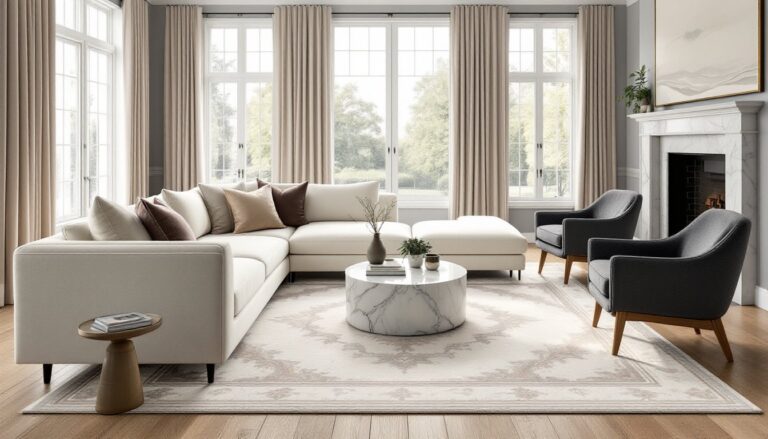
Start with large-scale textural elements: a chunky boucle sofa, a natural fiber area rug (jute, sisal, or wool with visible weave), or linen drapery panels with enough body to hold soft folds. These anchor the room’s textural foundation. Upholstered pieces should use fabrics with dimensional weaves, performance boucle, Belgian linen, or ribbed velvet rather than flat cottons or smooth synthetics.
Mid-scale textures come from accent pieces: rattan or cane chairs, plaster or ceramic table lamps, shagreen or lacquered side tables. These items catch light differently throughout the day, creating visual movement. A coffee table in white-washed oak or lime-washed wood adds grain pattern without introducing color.
Small-scale textures provide finishing detail: nubby throw pillows, cable-knit or faux fur blankets, hammered metal picture frames, or matte ceramic vases. Even switching outlet covers and switch plates from standard plastic to ceramic or plaster versions contributes to the overall textural story. Many designers working on luxury modern mansion projects use this layering technique to add sophistication without clutter.
Choosing the Right White Palette and Finishes
Not all whites are created equal, and selecting the wrong undertone can make a room feel dingy or harsh. Paint manufacturers offer hundreds of white options because subtle undertone shifts dramatically affect how a color reads in different lighting conditions.
For walls, stick with warm whites that contain slight yellow, beige, or greige undertones. Benjamin Moore’s White Dove, Sherwin-Williams’ Alabaster, or Farrow & Ball’s Pointing are industry standards for a reason, they read as true white without going cold or sterile. Avoid pure white or whites with blue/gray undertones in living spaces: they work in bathrooms or kitchens with abundant task lighting but feel clinical in rooms meant for relaxation.
Test paint before committing. Buy sample pots and paint 2×2-foot sections on multiple walls to see how light affects the color throughout the day. North-facing rooms skew cooler and benefit from warmer whites: south-facing rooms can handle slightly cooler tones. According to guidance from MyDomaine, undertone coordination across all whites in a room prevents the disjointed look that occurs when trim, walls, and furniture don’t harmonize.
Finish selection matters as much as color. Walls should be eggshell or satin (25-35% sheen) for easier cleaning and subtle light reflection. Flat paint shows every scuff in high-traffic areas. Trim, doors, and millwork perform best in semi-gloss (50-65% sheen), which resists fingerprints and wipes clean. Ceilings should remain flat white to minimize imperfections.
For woodwork and built-ins, consider a white-pigmented lacquer or conversion varnish rather than standard paint. These professional finishes, typically sprayed by finishing shops, provide a harder, more durable surface that resists yellowing. Expect to pay $75-150 per linear foot for custom built-ins with lacquer finish, but the longevity justifies the cost in a luxury application.
Furniture Selection for Elegant White Living Spaces
Furniture in a white living room must balance visual weight without creating harsh contrast. The all-white sofa works in theory but rarely in practice, it’s both high-maintenance and visually flat without surrounding texture.
For seating, consider upholstered pieces in natural linen, boucle, or performance fabrics in off-white, cream, or warm gray. Performance fabrics like Crypton or Sunbrella have evolved beyond outdoor-only applications: current versions convincingly mimic linen and velvet while resisting stains. Many luxury family homes use these practical fabrics to maintain the high-end look without constant professional cleaning.
Frame material affects perceived quality. Hardwood frames (kiln-dried oak, maple, or beech) with 8-way hand-tied springs signal quality construction. Avoid particleboard or engineered wood frames in luxury furniture, they fail faster and look cheaper. Furniture with exposed wood legs in walnut, oak, or brass-capped feet provides necessary visual grounding.
Scale furniture appropriately. In a 12×16-foot living room, a standard 84-inch sofa fits comfortably: larger rooms (16×20 feet or more) need sectional seating or multiple seating groups to avoid a furniture-island effect. Coffee tables should measure two-thirds the length of the sofa and sit 16-18 inches from the seating edge for comfortable drink placement.
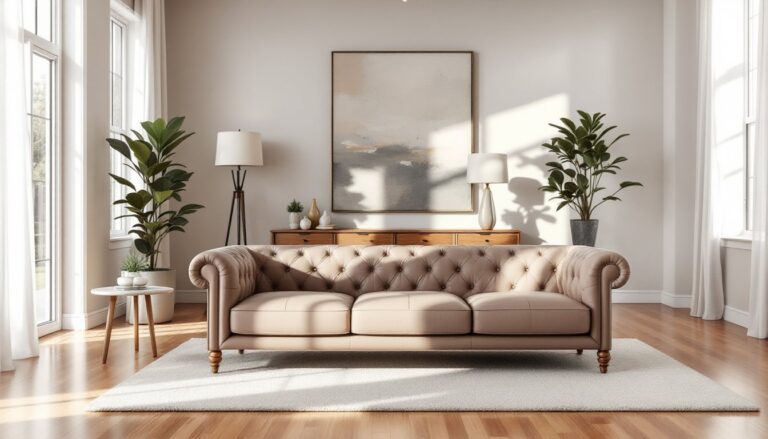
Accent chairs offer an opportunity for subtle pattern or texture contrast. Consider cane-back chairs with neutral cushions, channel-tufted velvet chairs in ivory, or sculptural molded plaster chairs. Avoid heavy pattern in upholstery: if pattern is desired, limit it to one accent chair and keep the scale appropriate to room size.
Case goods (side tables, consoles, media cabinets) should introduce material variety: white oak with cerused finish, lacquered white surfaces, marble or stone tops, or glass with brass or bronze frames. The best approach combines two to three distinct materials across all case pieces rather than matching everything.
Lighting Strategies to Enhance Your White Living Room
Lighting can make or break a white room. Too much overhead lighting creates a harsh, institutional feel: too little leaves the space feeling dingy even though the white palette. A proper lighting plan includes four layers: ambient, task, accent, and decorative.
Ambient lighting provides overall illumination. Recessed canned lights on dimmer switches offer the most flexibility, space them 4-6 feet apart in a grid pattern for even coverage. Use LED bulbs rated 2700K-3000K for warm white light that doesn’t skew cool. Avoid 4000K+ bulbs, which cast a blue-white light that makes white rooms feel sterile. Calculate 20 lumens per square foot for living areas: a 200-square-foot room needs approximately 4,000 lumens total.
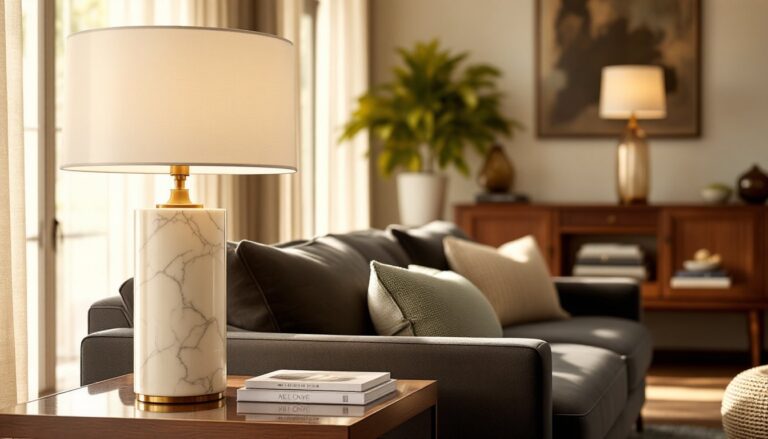
Task lighting serves specific functions. Floor lamps beside reading chairs should use 100-150 watt equivalent bulbs with adjustable heads. Table lamps on side tables provide secondary task lighting: pair them in matching heights for visual balance. According to ELLE Decor, coordinated lamp height creates rhythm that’s especially important in monochromatic spaces.
Accent lighting highlights architectural features or artwork. Picture lights or adjustable track lighting can showcase wall art: LED strip lighting in cove molding or behind floating shelves adds dimensional glow. Consider uplights in corners to wash walls and visually expand the room.
Decorative lighting provides visual interest through fixture design. A statement chandelier or pendant serves as sculptural art while providing light. For 8-foot ceilings, fixtures should hang at least 7 feet from the floor: for taller ceilings over seating areas, hang 30-36 inches above the coffee table surface. Natural materials like alabaster, linen, or rattan in fixture design reinforce the textural layering strategy. Homes incorporating smart luxury homes technology often use app-controlled lighting systems that adjust color temperature throughout the day.
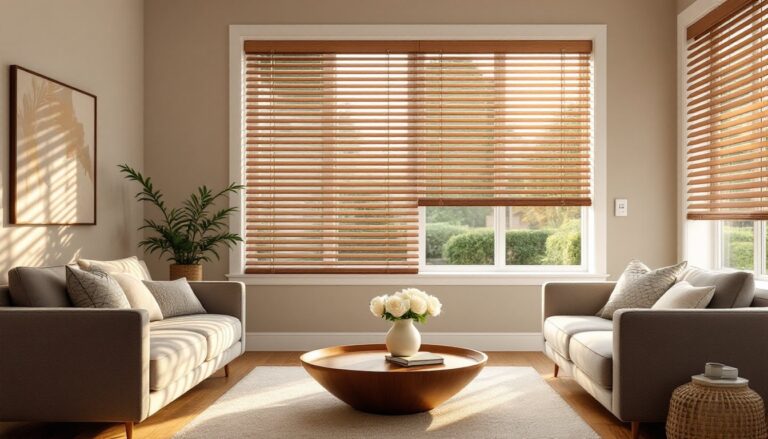
Don’t overlook natural light control. Motorized roller shades in sheer white or linen filter harsh sun while maintaining privacy. Layer them with drapes in natural linen for nighttime privacy and additional sound dampening. Hardware should be substantial, 1.5-inch diameter rods in matte brass, bronze, or matte black mounted 4-6 inches above the window frame and extending 8-12 inches beyond the frame on each side.
Maintaining a Pristine Luxury White Living Room
The honest truth: white living rooms require more maintenance than darker schemes. The good news is that with the right materials and routine, upkeep is manageable without professional help for most situations.
Fabric protection is non-negotiable. Apply Scotchgard or similar fabric protector to all upholstery immediately after purchase and reapply annually. Most stains can be spot-cleaned if treated within 24 hours. Keep a cleaning kit accessible: clean microfiber cloths, mild dish soap, white vinegar, and upholstery cleaner appropriate to fabric type. Never use bleach-based cleaners on natural fibers, they cause yellowing.
For walls painted in eggshell or satin finish, most marks wipe clean with a damp Magic Eraser (melamine foam sponge). Use gentle pressure to avoid burnishing the paint surface. Touch-up paint should be from the same batch as the original application: buy an extra gallon and store it in a cool, dark place. Paint color can shift slightly between batches.
Area rugs need regular rotation (every 6 months) to ensure even wear and sun fading. Vacuum weekly using the appropriate setting, beater bars can damage natural fiber rugs. Professional cleaning every 12-18 months keeps rugs looking fresh. For high-traffic areas, consider indoor/outdoor rugs in natural colorways, they’re designed for moisture and soil resistance while still looking sophisticated.
Hardwood floors maintain best with weekly dust mopping and monthly damp mopping with pH-neutral hardwood floor cleaner. Never wet-mop or use oil soaps, which build up residue. Furniture pads on all chair and table legs prevent scratching. Designers at Home Bunch frequently recommend professional refinishing every 7-10 years for white oak floors in high-traffic areas.
Window treatments collect dust. Vacuum drapes monthly using the upholstery attachment. Linen drapes may need professional cleaning every 2-3 years: factor that into your maintenance budget at approximately $3-7 per pleat depending on your market.
Set realistic expectations. A luxury white living room in a household with young children, pets, or frequent entertaining will show wear faster than one in an adult-only, low-traffic home. If your lifestyle includes any of these factors, prioritize performance fabrics, treated surfaces, and washable textiles over pristine but impractical materials. The best luxury rustic homes often incorporate forgiving materials that maintain the upscale aesthetic without constant vigilance.
A well-executed white living room rewards the effort with a timeless, flexible backdrop that adapts to changing decor preferences without requiring full redesigns. The key is committing to quality materials from the start and maintaining realistic expectations about upkeep requirements.